Golf Technology Far East
Main menu:
Putting
Golf Tips
How do I improve my putting?
Ninety-five percent of putts which finish short don't go in.
(Hubert Green)
The two main elements of putting are speed and direction. Both need to be right to hole a putt but in most cases it is speed that causes three, four (or more) putts and ruins a round of golf. It is rare for a golfer to miss a 20 foot putt to the left or right by 8 feet, but very easy to be short or long by 8 feet.
Judging Distance
When the military have to judge distance on a rifle range one of the methods used is that of choosing a shorter distance and then imaging how many times this distance will fit into the longer distance. For instance if you are six feet tall and trying to judge a long putt how many times would your body length fit between you and the hole.
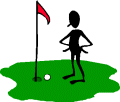
Not only does this method give you a feel for actual distance but you can start to develop a method for judging the strength of putt. Instead of practicing putting by aimlessly putting at holes of varying distance you can mentally mark out your body lengths on a putting surface and try to get the feel for the strength of putt needed to reach each length. This will obviously vary according to uphill or downhill putts but at least you are now establishing a method of focussing on the strength needed to reach a specific distance. Although much of this method is a mental exercise it is also an aid to physical touch and feel as you are setting a mental mark and the body is registering the feel and weight needed to reach the required distance.
Aiming
Just as in ten pin bowling many good bowlers do not aim directly at the pins but at the spots part way down the lane, so the same technique can be used in putting. Once you establish the general line of the putt, pick out a spot a few feet in front of you and aim to roll the ball over that spot.
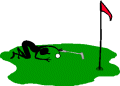
If a green has a lot of slope and breaks then plumb-bobbing is a good aid to finding out which way the putt is liable to break. Crouching low to see the actual contours of the green also works for many golfers, amateur and professional alike.
When you are putting always make sure that your weight is towards your toes. This will encourage the shoulders to be more over the ball and give you better contact with the ball.
The way I putted, I must've been reading the greens in Spanish and putting them in English. (Homero Blancas)
Equipment
The putter is very much a matter for individual choice and quite often will depend on the confidence you gain from using a particular brand, style or make. It is a fact, however, that some golfers will get better results from a blade putter than others. Some will find a heavy putter gives them more control whilst others like the feel of an extremely light putter as they feel it allows them to take a fuller swing. There is no right or wrong putter, just one that works for you. Try as many styles as possible until you find the weapon that is a killer for you. Have a look at the range of putters on this site and you will see three distinct variations in terms of weight and size. Just click on any of the pictures in the left hand column to have a look at that style of putter.
In summer, always use a two piece ball. The grass grows faster in the hot weather and the greens are slow so the two piece ball will come off the face of your putter faster and give you a few more inches that may just help the ball into the hole.
Other Aids
Always wear a cap or visor when playing. The peak on the cap limits your peripheral vision and cuts out a lot of extraneous distractions enabling you to concentrate better on the ball . Now you know why some pros wear caps even when it is not sunny.
The putting green is the only time we are allowed to pick up the ball during the course of the hole.
Always mark your ball and clean it. A small piece of dirt may be attached to the ball and that can affect the roll and direction, a clean ball gives us a better chance to hole the putt.